Speculative Architecture / Research
Folios — 2024 / 2026 —
Speculative Architecture Reel · silent / loop Project №01 / 2026
Project №01 / 2026
Architecture of Folded Geometry

Piano
Factory.

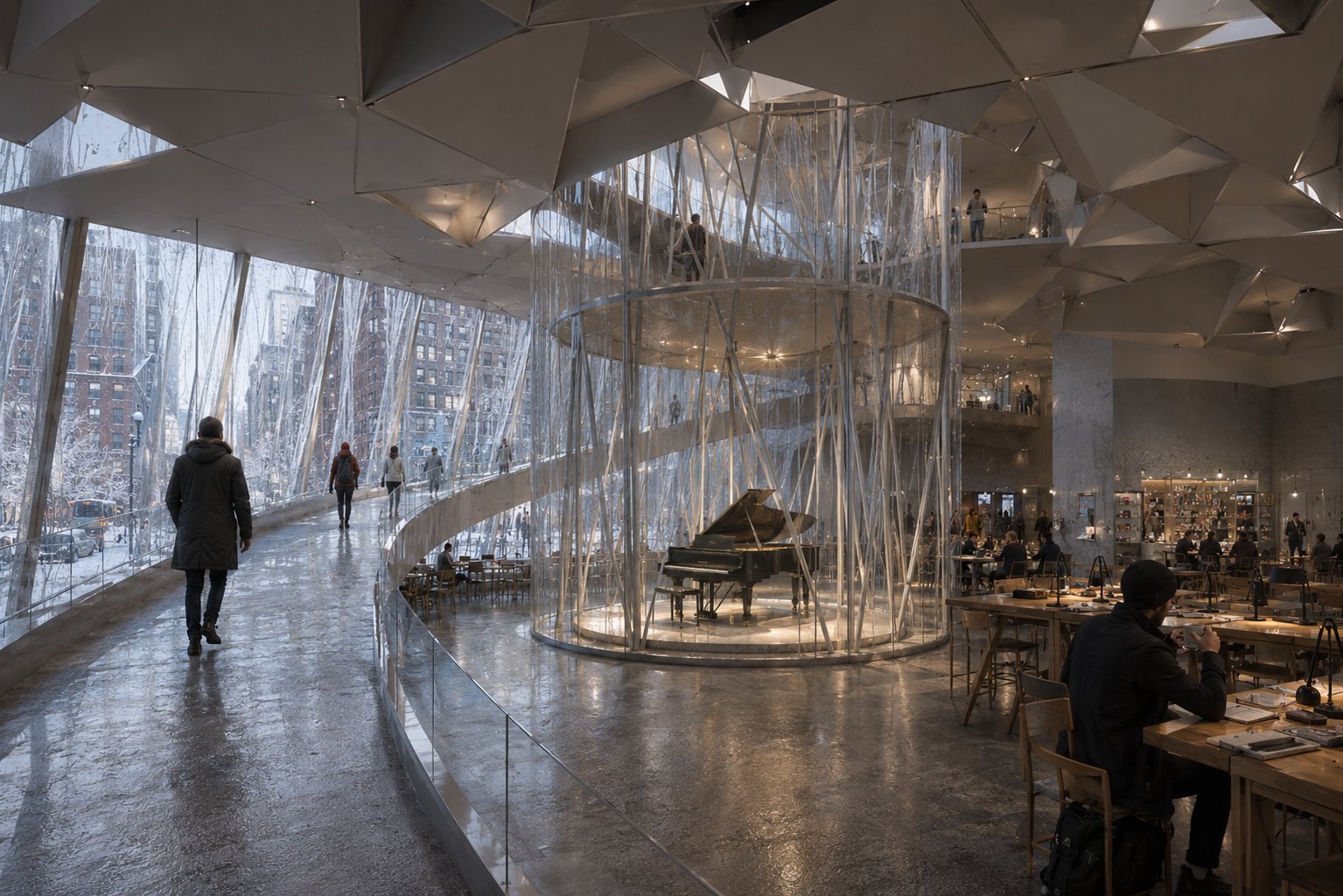
A building whose exterior language is repeated within. ETFE folds become ceiling; the structural lattice becomes the geometry under which the piano sits. Inside and outside speak the same vocabulary.

Type
Cultural / mixed-use
Site
Printers Row, Chicago, IL
Across from
Dearborn Train Station
Programme
Piano factory · public hall
Skin
ETFE membrane / glass
Method
Geometry refolded
Status
Research / unbuilt
/ 01 — Plate I. Before / after.

From the outside inwards.

The exterior language repeats itself within. The ETFE folds become ceiling, the membrane becomes wall, the structural lattice becomes the geometry under which the piano sits. Inside and outside speak the same vocabulary.

Exterior — the building as seen from the street
Interior — the same language, refolded
Exterior Interior
— the exterior language refolded as interior —
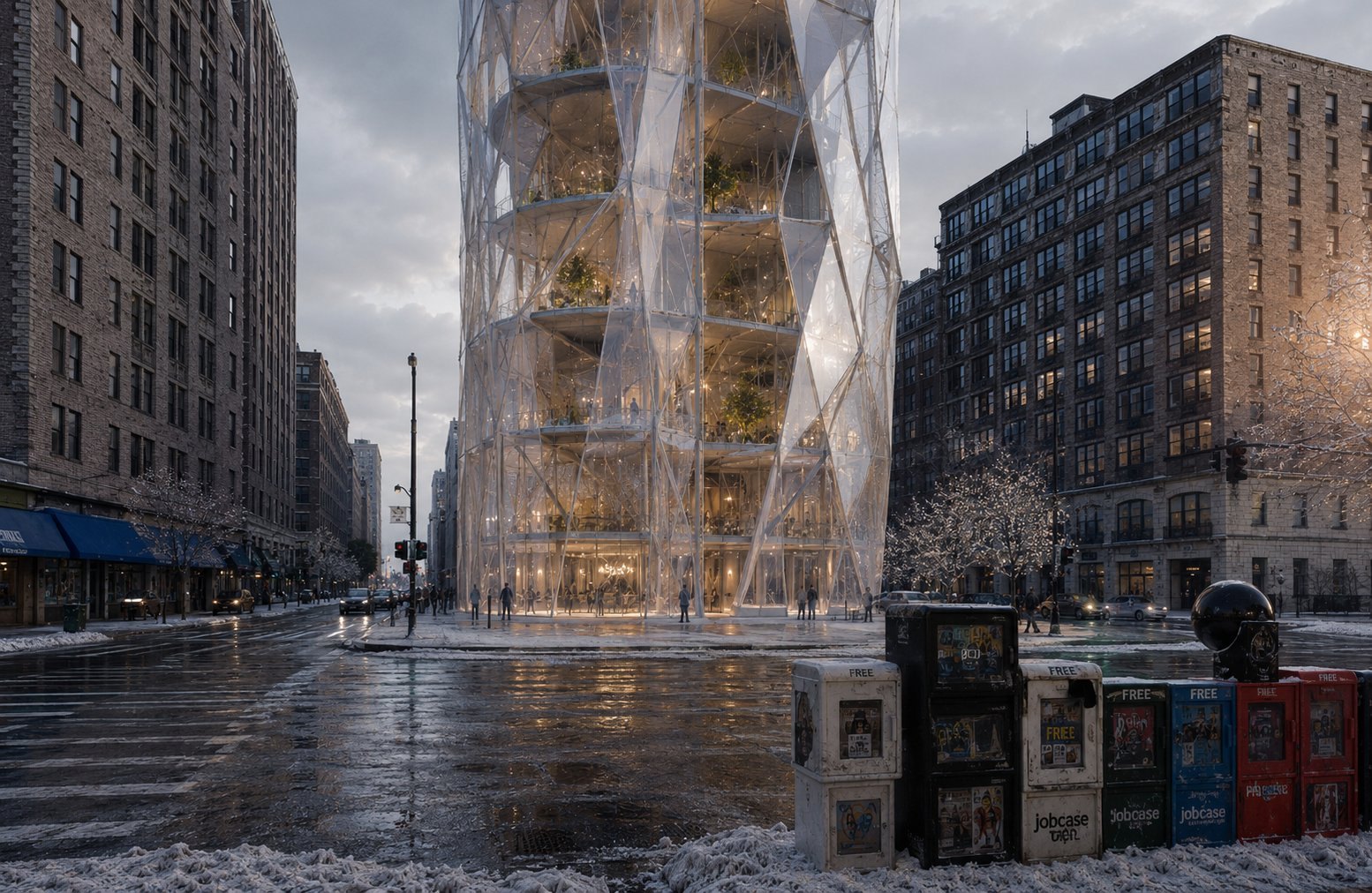
Plate I Exterior / Interior. The crystalline envelope refolds itself inside the building. What is read as façade from the street becomes shelter from within — a single geometric idea inhabited at two scales. Diptych render · 2026
/ 02 — Abstract

The conventional building speaks one language outside, another within. Piano Factory refuses the division.

An outer skin of ETFE membranes is held in tension between glass panels by a lattice of thin steel members. The same lattice — the same folds, the same geometry — is then carried inward to become the ceiling above the piano hall. The wall is the ceiling is the structure. The reader at the centre is inside the same idea they read from the street.

A building of one vocabulary, spoken at two scales.

Keywords Folded geometry ETFE membrane Inside / outside Structural repetition Public concert hall One vocabulary
/ 03 — Spatial sequence
  1. StreetFaçade as fold
  2. ThresholdMembrane held in tension
  3. LobbyGlass meets ETFE
  4. HallLattice as ceiling
  5. PianoInside the same geometry

The visitor moves from the sidewalk to the instrument without leaving the building's geometry. The same fold is encountered at five scales: as silhouette, as edge, as window, as ceiling, as the room around the piano.

Plate II
Plate II From the street. The ETFE skin folds along the lattice — the same lattice that, indoors, becomes ceiling. Birds and migrating monarchs shelter in the gap between the layers. Render · 2026
Plate III
Plate III Inside the same fold. The ceiling repeats the exterior. The piano sits beneath a roof that is structurally and visually identical to the façade that brought the visitor here. Render · 2026
Plate IV
Plate IV The corner at dusk. The interior is read from outside through the membrane. The exterior is read from inside through the same surface. A building made of one geometry, twice inhabited. Render · 2026
/ 04 — Notes

On folding.

A — On one vocabulary

Most buildings are bilingual: a public language outside, a private one within. The exterior is composed for the city; the interior is composed for the occupant. The two rarely speak to each other.

Piano Factory begins from the refusal of this division. The premise is that a building should speak one vocabulary, and that the experience of moving from outside to inside should not be a translation but a continuation. The visitor does not enter a different building. They enter the same building, from a different position.

The ETFE membrane is the carrier of this idea. Its folds are calibrated to a single structural logic — a steel lattice held in tension at the perimeter. That lattice does not stop at the façade. It continues inward, drops as the ceiling above the piano hall, then turns again to compose the soffit of the upper reading floor.

The fold is read at five scales: as silhouette from the avenue; as edge against the sky; as window at the threshold; as ceiling in the hall; as the immediate roof above the instrument. The visitor walks into the geometry they were already looking at.

This is not a virtuoso gesture. It is a discipline. Once the lattice is set, every interior surface follows. Every detail — handrail, balustrade, lighting bracket — is derived from the same fold. The building authors itself.

/ 05 — References
  1. Eisenman, P. (1999). Diagram Diaries. New York: Universe.
  2. Moussavi, F. (2009). The Function of Form. Cambridge: Harvard GSD / Actar.
  3. Lynn, G. (1999). Folding in Architecture. London: Wiley-Academy.
  4. Ito, T. (2009). Tarzans in the Media Forest. London: Architectural Association.
  5. SOM. (2018). Printers Row Historic District Survey. Chicago: City of Chicago.
  6. Yoshikawa, S. (2002). The Acoustics of the Concert Hall. Tokyo: Ongaku no Tomo.
Speculative Architecture Reel · silent / loop Project №02 / 2026
Project №02 / 2026
Speculative Masterplan

Irregular
City.

A speculative masterplan. The city as a translucent organism, bound by a single hydrological cycle.

Type
Speculative masterplan
Site
Coastal — undisclosed
Programme
Hydrological urbanism
Mediums
Render, axonometric, section
Status
Research / unbuilt
Year
2026 —
Plate I — the urban fabric
Plate I The city as filtration apparatus. Crystalline volumes channel six water cycles. Render · 2026
/ 00 — Abstract

Six water cycles — saline, grey, geothermal, rain, sewage, industrial — generate the spatial sequence. Each district is a station in a continuous metabolism.

Infrastructure is not concealed beneath architecture but constitutes it. Pink piping is made legible against concrete and glass.

Keywords Hydrological urbanism Speculative masterplan Infrastructural transparency Coastal ecology Urban metabolism
Plate II
Plate II Section through the water plaza. Grey-water cycle, geothermal wells, septic logic. Section drawing · 2026
Plate III
Plate III Aerial — residential cluster. Envelope as shelter and atmospheric instrument. Render · 2026
Plate IV
Plate IV Water edge — threshold between infrastructure and inhabited ground. Render · 2026
Plate V
Plate V Masterplan with building type catalogue: helio-morphic, wind-aligned, embracing, square-cove. Plan / collage · 2026
Plate VI
Plate VI Ground condition. The pipes are inhabited, not hidden. Render · 2026
/ 01 — Notes

Research notes.

A — On method

The drawings hold two ideas at once: the schematic logic of the hydrological system, and the atmospheric experience of inhabiting it.

The pink is not decoration — it is borrowed from infrastructural codes, the colour of recycled water lines, and re-deployed at architectural scale. Where convention asks pipes to disappear, here they become façade, structure, threshold.

The work was developed without a brief. There is no client. The site is undisclosed. The plates are not proposals — they are positions.

/ 02 — References
  1. Banham, R. (1969). The Architecture of the Well-Tempered Environment. London: Architectural Press.
  2. Easterling, K. (2014). Extrastatecraft: The Power of Infrastructure Space. London: Verso.
  3. Koolhaas, R., AMO. (2014). Elements of Architecture. Venice: Marsilio.
  4. MVRDV, The Why Factory. (2018). Copy Paste: The Badass Copy Guide. Rotterdam: nai010.
  5. Smithson, A. & P. (1965). The Charged Void: Urbanism. New York: Monacelli.
  6. Young, L. (2020). Planet City. Melbourne: Uro Publications.
Speculative Architecture Reel · silent / loop Project №03 / 2026
Project №03 / 2026
Landscape / Demilitarisation
서생원 鼠生員

Seosengwon.

A protocol for clearing the Korean DMZ. The work renames the African pouched rat Seosengwon — the honourable rat of Korean folk painting — and gives it a new occupation: peace.

Type
Landscape / protocol
Site (strip)
Korean DMZ, 38°N
Site (campus)
Kaesong Industrial Region
Length
250 km
Width
4 km strip
Mines (est.)
~ 1,000,000
Protagonist
서생원 · the rat
Time horizon
2026 — 2076 (50 yr)
Status
Research / unbuilt
Seosengwon — frontispiece
서생원 鼠生員 Frontispiece · 2026
Plate 0 Seosengwon, robed in hanbok, stands on the old Gyeongui Line between Seoul and Pyongyang. The mines are rusted, the rail is broken, the animals have returned. Frontispiece · 2026
Plate I
Plate I Two soldiers — one from each side — watch the Seosengwon locate a buried mine. The rat is too light to trigger the device. The men have stopped working. This is the work. Render · 2026
Plate II
Plate II Two soldiers, two Seosengwon, one minefield. The characters above the horizon — 평화 통일 — name the impossible thing the protocol attempts. Render · 2026
/ 00 — Abstract

The DMZ is the most heavily mined strip of land on earth. It is also, by accident, one of the most ecologically intact landscapes in northeast Asia.

The proposal is a 50-year demining protocol carried out jointly by the two Koreas. Its protagonist is a rat — too light to detonate a mine, trained to detect explosives by smell. The work renames it Seosengwon, the honourable rat of Korean folk painting, and gives it a new occupation.

Watchtowers are kept. Fences are removed slowly. The forest stays. Architecture, here, is the choreography of retreat.

Keywords Seosengwon DMZ Demining Folk-painting reframed Bilateral protocol Rewilding
/ 01 — Sites
38°15′N · 127°36′E
Cheorwon plain

Old battle site. Heaviest mine density. Habitat for the Korean crane.

38°02′N · 127°02′E
Yeoncheon corridor

River crossing. The Hantan flows through the strip — a soft border.

38°22′N · 128°16′E
Goseong coast

East end. Where the DMZ meets the sea. Migratory bird stop.

Plate III
Plate III Aerial — clearance grid. Each cell is 4×4m. Workers advance in pairs. The old railroad to the north persists, untouched. Render · 2026
Plate IV
Plate IV The corridor at noon. Watchtowers are kept as monuments to the old border. The fences are slowly cut. The forest holds. Render · 2026
/ 02 — Facility / Plate V

The campus at Kaesong.

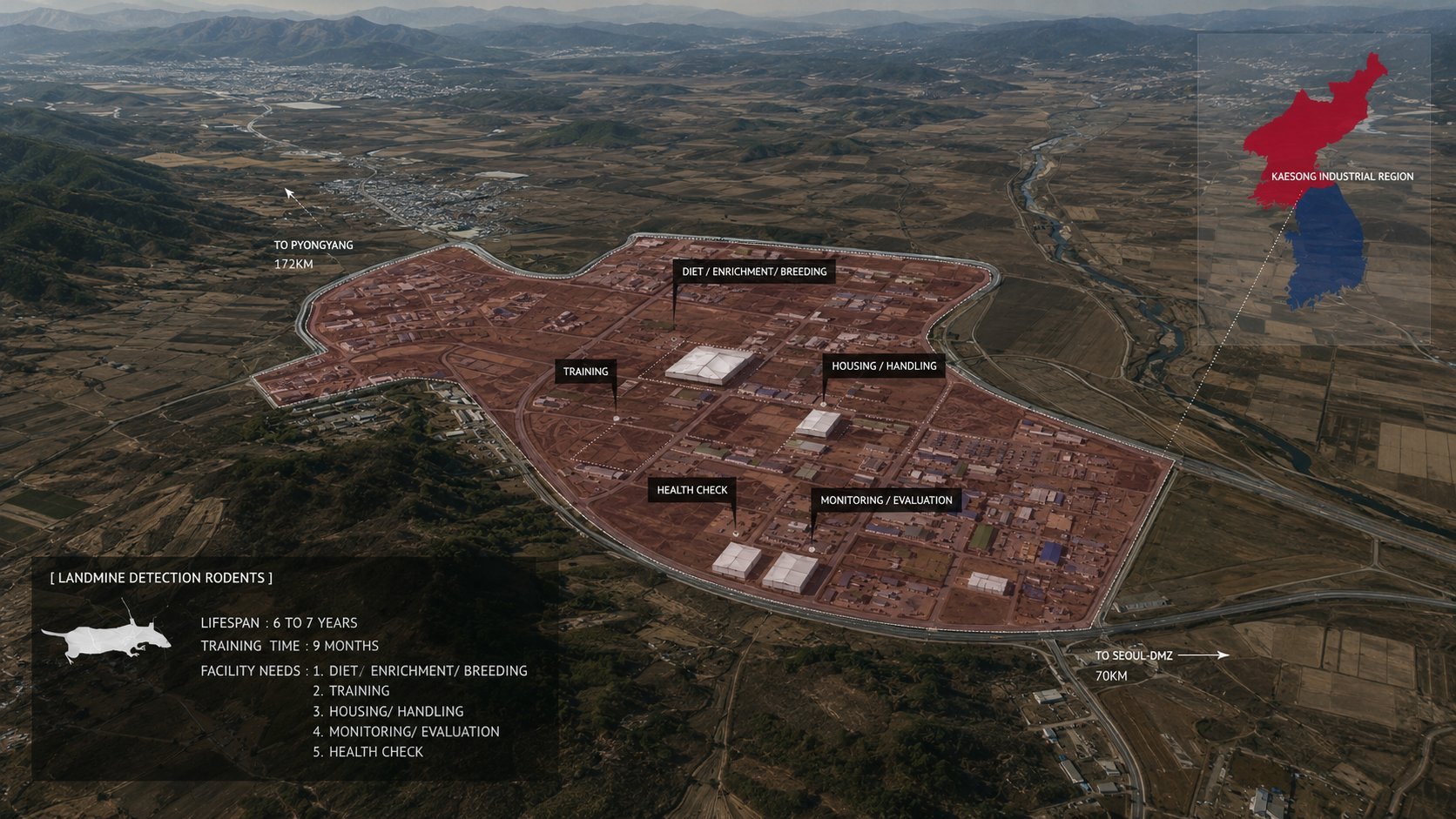
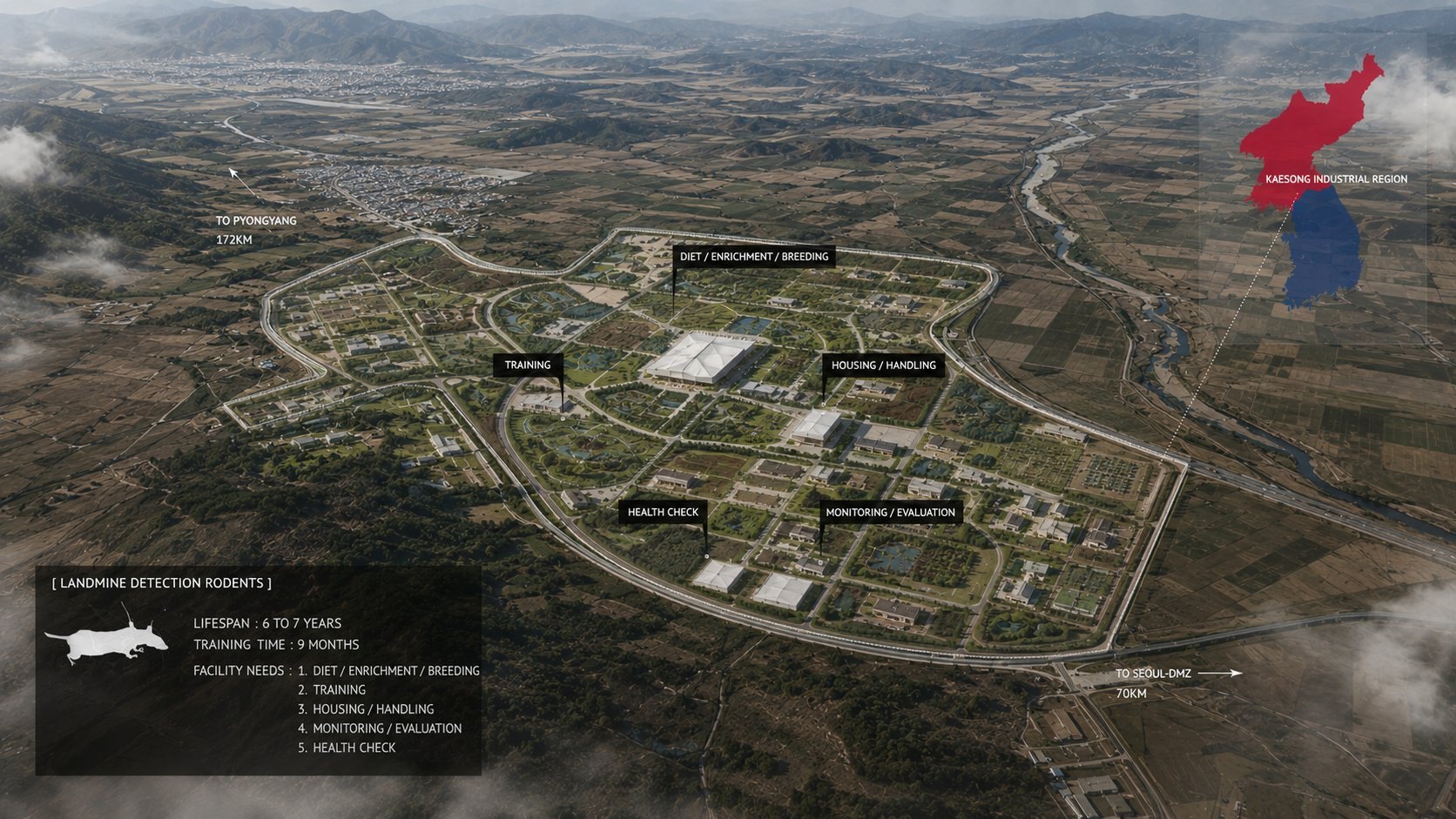
The protocol needs a home. Sited on the abandoned Kaesong Industrial Region — 70km from Seoul, 172km from Pyongyang — a bilateral facility where the Seosengwon are bred, trained, housed, and retired.

Today — industrial
Proposal — campus
Today / Industrial Proposal / Campus
— the same site, dissolving from industry to campus —
Plate V Aerial of the Kaesong site, before and after. Five facilities — breeding, training, housing, monitoring, health — held within a single ring road. Aerial render · annotated · 2026
/ 03 — Programme
  1. 01Diet / Enrichment / BreedingReproduction and behavioural enrichment. The pups stay with their mothers for ten weeks.
  2. 02TrainingNine months of clicker-and-reward training, TNT recognition by scent, lead-work.
  3. 03Housing / HandlingDaily housing in small social groups. Handlers rotate to prevent imprinting.
  4. 04Monitoring / EvaluationTest fields of inert mines. Each Seosengwon is re-certified annually.
  5. 05Health CheckVeterinary clinic. Retirement at year seven. Burial on site.
Lifespan6 — 7 years
Training time9 months
To Seoul–DMZ70 km
To Pyongyang172 km
SiteKaesong Industrial Region
/ 04 — Glossary

Terms of the protocol.

A — Bilingual
/ 05 — Notes

On the border that was.

A — Method

The protocol assumes co-operation. This is itself the speculation. Two military commands, working in pairs, in 4×4m grid cells, advancing 80m per year. At this pace, the strip is cleared in fifty years.

The rat does the seeing. A human pulls the lead. A second human, on the other side of the lead, watches. The triangular yellow signs — written in three languages, 지뢰 / MINE / 地雷 — are removed only after the cell is verified.

Architecture builds. This work proposes that architecture can also unbuild. The protocol designs the choreography of removal — fences, mines, signs — while keeping what the strip itself produced: the forest.

Keep the watchtowers. Keep three of them, well-spaced, as physical citation. Everything else returns to forest, to river, to ground.

/ 06 — References
  1. Kim, E. (2014). The Plant: A Korean DMZ Field Report. Seoul: Hyohyung.
  2. APOPO. (2022). HeroRAT Detection Protocols, Version 7. Morogoro, Tanzania.
  3. Cumings, B. (2010). The Korean War: A History. New York: Modern Library.
  4. Kwon, H.-Y. (2018). Borders and Belongings in Divided Korea. Stanford University Press.
  5. UN Mine Action Service. (2024). Global Landmine Status Report. Geneva.
  6. Lee, S. (2019). Wild DMZ: Sixty Years of Accidental Wilderness. Paju: Munhakdongne.
Speculative Architecture Reel · silent / loop Project №04 / 2024
Project №04 / 2024
Library / Civic — Columns Instead of Walls

Authentic Forest
of Learning.

A library without walls. Organic concrete columns stand in for tree trunks. The floor itself is a bookshelf — readers settle into it the way one settles into the forest floor.

Type
Library / civic
Site
Chinatown, Chicago IL
Programme
Public library · learning space
Structure
Concrete columns, no walls
Material
Concrete · wood · vegetation
Studio
M.ARCH Core Studio
School
School of the Art Institute of Chicago
Year
2024
Plate I — the reading floor
Plate I A child reads against the base of a column. The curved floor-bookshelf — a piece of architecture made for sitting, not standing. Render · 2024
/ 00 — Abstract

It is a place to be creative, free, and comfortable — like sitting down at a spot to read in the woods. The floor bookshelves engage the user with the ground plane of the building.

The organic shaped columns represent tree trunks. They are densest along private areas, and sparser in public lounges. Each column carries a ventilation system within. Concrete — at once cool and warm — is the primary material.

Natural light is introduced through openings on the ceiling, designed along the shape of beams on the columns.

Keywords Library Columns instead of walls Floor bookshelves Concrete forest Civic space Chinatown
Plate II — the community lounge
Plate II The community lounge. Columns thin out, the floor opens up. Reading is no longer private — it is shared, overheard, watched. Render · 2024
Plate III — exploded axonometric
Plate III Exploded axonometric. The building is read in five strata: daylight openings, beams, the column lattice, the upper reading floor, and the ground entrance. Solar geometry from 25° winter low to 73° summer noon is plotted at the top. Studio drawing · 2024
Plate IV — 1st and 2nd floor plans
Plate IV Floor plans, 1F and 2F. The plan follows the sidewalk curve at the corner of S. Archer and S. Wentworth — a fan-shaped footprint opening toward two streets. Thirteen zones: lobby, sunken gathering, open lounge, work, social, quiet lounge, reading nooks, terrace. Drawing · 2024
Plate V — column meeting slab
Plate V Column meeting slab. Where the tree-trunk concrete columns flare outward to receive the upper floor — a detail repeated dozens of times across the plan, never quite identical. Render · 2024
/ 01 — Notes

On columns.

A — On method

The premise is structural and atmospheric at once: replace the wall as the primary spatial element with the column.

Walls divide. Columns gather. A library organised by columns is a library in which the boundaries between rooms are negotiable, and the reader's body — not the architect's plan — defines the space.

The floor bookshelves are not a graphic move. They acknowledge a fact about reading: that the body wants to settle, to lean, to lie down. The architecture provides the surfaces for this.

Columns are densest at the perimeter and along the private reading rooms. They thin out toward the centre, where the public lounge gathers. The plan is a forest with a clearing.

/ 02 — Acknowledgements
  1. Studio: M.ARCH Core Studio, School of the Art Institute of Chicago.
  2. Aalto, A. (1935). Viipuri Library. Vyborg.
  3. Kahn, L. (1972). Exeter Library. Phillips Exeter Academy.
  4. Borges, J. L. (1941). The Library of Babel. Buenos Aires: Sur.